
Workers compensation case manager recruitment is the process of hiring claims professionals to manage workplace injury cases with the aim of supporting sound claims decisions, appropriate communication and return-to-work activity within the role’s authority. This guide is for Australian employers planning a 2026 hire: define the actual casework, assess judgement against that work, and give the successful candidate a supported handover.
- Workers compensation case manager recruitment should start with case complexity, decision authority and supervision—not a job title alone.
- HAYLO People suits employers seeking specialist recruitment support for workers compensation and Personal Injury roles.
- Use a fictional claims scenario to assess judgement without requesting confidential claimant information.
- Agree selection criteria, feedback responsibilities and onboarding support before approaching candidates.
Why recruitment matters for workers compensation employers
A case manager title does not define a vacancy. One employer needs someone to manage established claims independently; another needs a developing professional supported by technical specialists. Advertising both positions in the same language leaves candidates guessing about accountability.
Assess the work you need done, not the familiarity of a candidate’s previous job title. Your hiring brief should distinguish case ownership, stakeholder communication, technical escalation and return-to-work coordination. State which responsibilities sit elsewhere in your business.
HAYLO People provides permanent, temporary and executive recruitment across Personal Injury, General Insurance and Work Health & Safety. For this employer-focused guide, the priority is the workers compensation case manager vacancy—not a broader insurance recruitment brief or a candidate career overview.
Recruitment cannot resolve an unclear operating model. Before opening a vacancy, decide who supervises the position, what authority it carries and which matters require technical review. Those decisions shape both your assessment and the explanation candidates receive.
How to recruit a workers compensation case manager
Use the following sequence for your 2026 hiring plan. Complete the role and assessment decisions before inviting applications; leave candidate-specific checks and appointment decisions until you have evidence to assess.
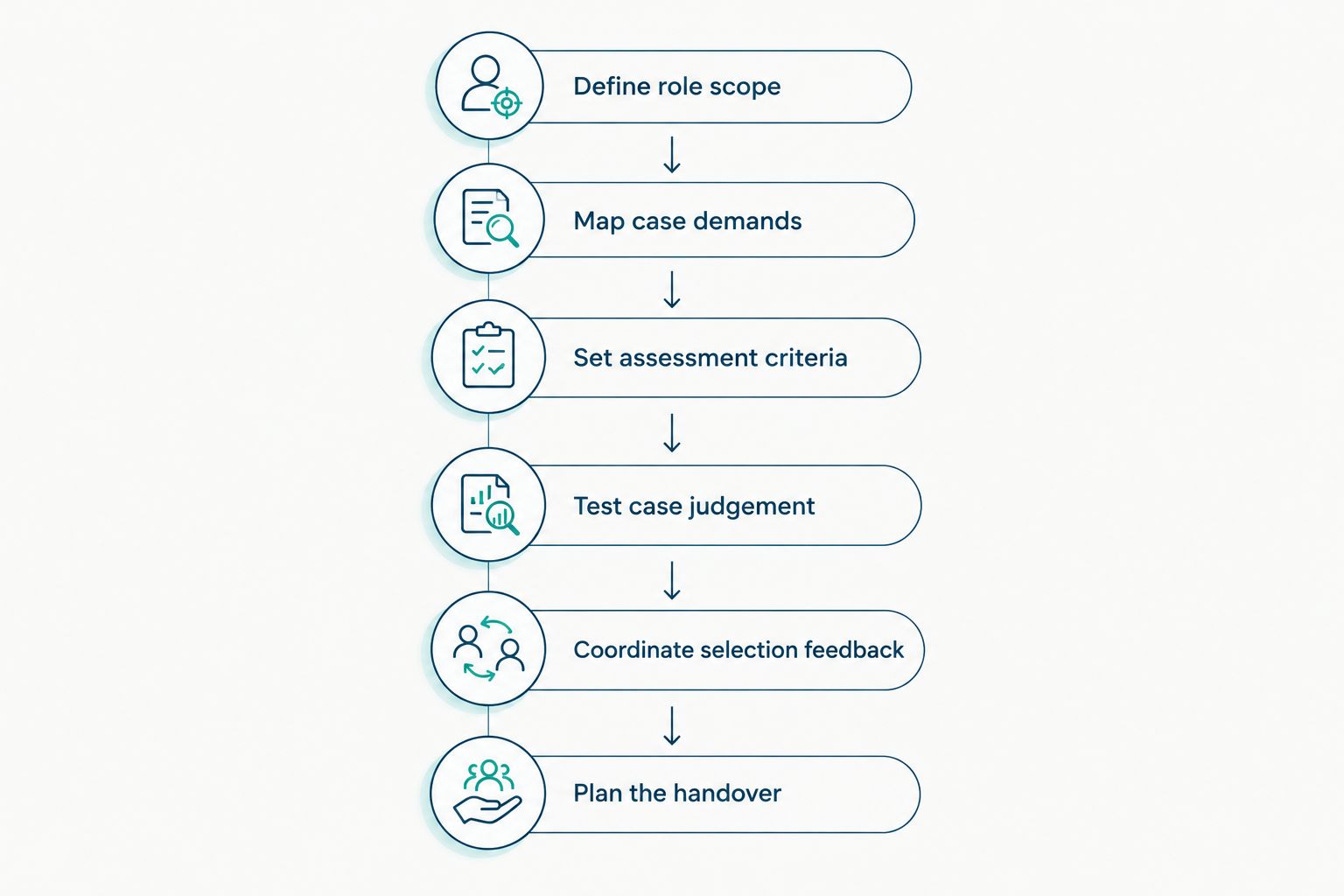
Define role scope
Start manually with a one-page role brief. Write down what the case manager will own, what they will recommend and what they must escalate. Keep the position description as supporting material rather than expecting it to answer every briefing question.
Distinguish essential experience from knowledge you can teach. If your business can provide technical coaching, explain its scope. If the position requires independent handling of particular decisions from commencement, identify those decisions rather than using an undefined requirement such as senior experience.
Confirm the employment arrangement and reporting line. A temporary appointment covering an absence needs a different explanation of continuity and handover from a permanent appointment intended to develop within a team.
Close the brief with observable responsibilities:
- State whether the role owns claims end to end or handles a defined stage.
- Identify the decisions the case manager can make independently.
- Name the technical, clinical or legal escalation functions available.
- Separate essential experience from trainable systems knowledge.
- Confirm the employment arrangement, reporting line and work location expectations.
Map case demands
Describe the work behind the caseload before discussing a target number. Case volume alone does not show how much investigation, communication or coordination a position requires. Explain the mix of cases and the support surrounding them.
Document the current workflow manually with the hiring manager and an experienced team member. Use de-identified examples of routine work and difficult handovers. Do not circulate claimant files as recruitment briefing material.
HAYLO People can support recruitment for workers compensation roles; your responsibility is to supply an accurate account of the vacancy. A specialist recruitment brief gives the discussion a clear starting point, but the employer retains responsibility for defining authority, supervision and appointment requirements.
For your 2026 vacancy brief, make the workload explicit:
- Describe the claim stages and types of matters the position handles.
- Explain the expected contact with workers, employers and treatment stakeholders.
- Identify inherited work, outstanding actions and handover arrangements.
- Record the administrative and technical support attached to the position.
- Explain how priorities are reviewed when competing tasks arise.
Set assessment criteria
Create a shared assessment sheet before reviewing applications. Use the same core criteria for each candidate so that an impressive interview does not displace evidence of relevant work.
Separate claims knowledge, communication, judgement and organisation. A candidate who explains legislation confidently still needs to demonstrate clear file reasoning and appropriate escalation. Equally, unfamiliarity with your internal system is not the same as an inability to manage competing priorities.
Use two interviewers as a suggested assessment design, with each recording observations before discussing a recommendation. This is a process choice, not a requirement. The purpose is to preserve the evidence behind the decision rather than allowing the first opinion expressed to set the result.
Build the assessment sheet around practical questions:
- What evidence demonstrates relevant claims responsibilities?
- How does the candidate explain a difficult decision respectfully?
- When does the candidate seek technical advice or escalate uncertainty?
- How does the candidate organise actions and maintain usable records?
- Which capability gaps can your team support after appointment?
Test case judgement
Use a fictional scenario that reflects the vacancy without reproducing a real worker’s circumstances. Assess the candidate’s reasoning, information gathering and communication—not their ability to guess an unstated answer.
A suggested format is a 30-minute exercise followed by a discussion. Give every candidate the same instructions and explain what you assess. Where the exercise involves jurisdiction-specific questions, confirm the answer guide with an appropriately qualified internal specialist before using it.
For example, present a file with competing contact requests, incomplete information and an approaching internal review point. Ask the candidate to explain what they would clarify, what they would record and which decisions sit outside their authority. Do not turn the exercise into unpaid work on a live claim.
Assess the response against defined evidence:
- Identify missing information before reaching a conclusion.
- Distinguish immediate actions from matters requiring further review.
- Explain communication choices for different stakeholders.
- Record the reasoning behind a proposed next step.
- Recognise authority limits and appropriate escalation points.
Coordinate selection feedback
Assign an employer decision-maker and agree how interview feedback will reach them. A candidate should not receive conflicting explanations of the role from different interviewers.
Record evidence against the assessment criteria immediately after each discussion. Replace comments such as good fit with observations about relevant responsibilities, judgement or communication. If an interviewer raises a concern, identify the evidence needed to resolve it before adding another interview.
Keep your 2026 selection records focused on the vacancy. Apply your organisation’s privacy, retention and access procedures to applications, assessment notes and referee information. Obtain the candidate’s permission before contacting referees, and agree how to handle current-employer sensitivities.
Keep the decision process clear:
- Name the person authorised to approve the appointment.
- Agree who consolidates interview and assessment feedback.
- Resolve contradictory role information before the next candidate conversation.
- Seek referee evidence relevant to the responsibilities being assessed.
- Tell candidates the next step and who will communicate it.
Plan the handover
Prepare onboarding before the successful candidate starts. An accepted offer is not evidence that someone is ready to receive unsupervised case responsibility. Match the handover to demonstrated capability and the support you have committed to provide.
Set out who introduces systems, who reviews early work and who answers technical questions. If the new starter inherits cases, nominate the person responsible for explaining outstanding actions and identifying matters requiring attention.
Keep employer onboarding separate from scheme-specific or professional requirements. Confirm applicable requirements for the role and jurisdiction rather than assuming previous employment establishes current readiness. Where a candidate needs development, put that support into the onboarding plan rather than leaving it as an interview promise.
Prepare a practical handover checklist:
- Confirm access permissions and required internal induction.
- Identify supervision and technical escalation contacts.
- Explain outstanding actions on transferred cases.
- Agree which work requires review before release or action.
- Schedule a check-in to assess workload and training needs.
Compare recruitment approaches for your vacancy
Choose a recruitment approach according to your internal capacity and the work involved. These are process options, not agency rankings. Each offers a benefit and leaves responsibilities with the employer.
| Option | Best for | Practical benefit | Key limitation |
|---|---|---|---|
| Employer-led recruitment | Employers with internal sourcing and assessment capacity | Direct control of candidate communication and selection | Your team must manage sourcing, coordination and specialist assessment |
| Specialist recruitment support | Employers seeking help recruiting workers compensation professionals | Adds external recruitment support to a defined vacancy | The employer must still specify responsibilities and make the appointment decision |
| Internal appointment | Employers with an employee whose capability matches the work | Allows assessment against work already observed internally | The move can create another vacancy and still requires a proper handover |
| Temporary appointment | Employers addressing a defined coverage requirement | Creates a staffing option for a stated period or purpose | Access, supervision and case continuity still need planning |
Start with what your team can deliver manually. If sourcing or recruitment coordination needs external support, discuss that gap with a specialist recruiter rather than assuming an agency brief replaces employer preparation.
HAYLO People suits employers seeking specialist recruitment support for workers compensation and Personal Injury roles. Its recruitment service does not replace your responsibility to verify role requirements, evaluate evidence or provide appropriate supervision.
Discuss your case manager vacancy
Explain the role scope, case demands and recruitment support your business needs.
Common mistakes workers compensation employers make
Treating previous titles as proof of readiness
A previous case manager title does not establish the candidate’s decision authority, case exposure or supervision needs. Ask for examples of responsibilities personally held, then compare those examples with your vacancy.
Presenting a caseload without its operating context
A headline caseload figure leaves out inherited actions, administrative support and case complexity. Explain those conditions so candidates can assess the work accurately and interviewers can test relevant capability.
Testing recall instead of practical judgement
A technical question has a place when it matches an essential responsibility. It should not crowd out evidence of information gathering, respectful communication, record keeping and escalation. Assess how the candidate reaches a decision as well as the answer.
Promising support without assigning it
An assurance that training is available needs an owner and a defined scope. Confirm who provides supervision and which work receives review before presenting development support as part of the role.
Requesting confidential examples to prove experience
Do not ask candidates to bring identifiable claim files, internal reports or correspondence from another employer. Ask for de-identified explanations of their responsibilities or use your own fictional exercise instead.
FAQ
What should a workers compensation case manager recruitment brief include?
A workers compensation case manager recruitment brief should define case responsibilities, decision authority, case demands, supervision and assessment criteria. Separate essential experience from skills your team can teach, and confirm the employment arrangement and reporting line.
How do I assess a case manager without using real claim files?
Use a fictional case scenario and assess the candidate’s reasoning against criteria agreed in advance. Ask what information they need, how they would communicate and when they would escalate, without requesting confidential material from another employer.
Should I hire a temporary or permanent case manager?
Choose the employment arrangement according to the purpose and expected continuity of the vacancy. Define the coverage requirement, supervision and handover before deciding; neither arrangement removes the need to assess capability.
Can I recruit someone without experience in my internal claims system?
Treat internal system knowledge separately from claims capability when defining essential criteria. Assess the candidate’s relevant responsibilities and learning needs, then confirm whether your team can provide the necessary system training.
What does an employer still need to do when using a specialist recruiter?
The employer still needs to define the vacancy, provide accurate working conditions, assess evidence and approve the appointment. The employer also remains responsible for arranging appropriate onboarding, access and supervision.
How should I check workers compensation jurisdiction experience?
Ask candidates to describe the jurisdiction, responsibilities and authority attached to their previous work. Verify any essential requirements for your vacancy with an appropriately qualified specialist rather than treating all Australian scheme experience as interchangeable.
What should candidates ask before accepting a case manager role?
Candidates should ask about case responsibilities, decision authority, supervision and the condition of inherited work. They should also clarify how training needs will be addressed and who will provide technical support.
One last thing
Before approving a 2026 advertisement, ask the hiring manager and proposed supervisor to describe the vacancy separately. Compare their answers on authority, case demands and support. If those descriptions differ, resolve the vacancy internally before asking a candidate to commit to it.