
General insurers’ underwriter recruitment is the process of hiring people to assess and accept insurance risks, with the aim of supporting sound portfolio decisions. This guide is for Australian underwriting leaders and hiring managers: your brief needs to distinguish product knowledge, delegated authority and commercial judgement before you assess candidates.
- HAYLO People suits general insurers seeking specialist recruitment support for permanent, temporary and executive appointments.
- For underwriter recruitment general insurance employers should define portfolio scope, authority limits and referral expectations before shortlisting.
- Assess underwriting judgement through fictional risk scenarios, structured interviews and role-relevant reference checks.
- Choose the employment arrangement around the work, then document supervision and onboarding responsibilities.
Why underwriter recruitment matters for general insurers
An underwriting title is not a hiring specification. Two candidates with the same title can bring different product exposure, distribution experience and decision-making responsibilities. A useful brief makes those differences visible rather than leaving interviewers to interpret a CV.
For a 2026 vacancy, start with the decisions the new employee will own. Reviewing renewal terms, handling broker submissions and referring risks outside authority are different responsibilities; your assessment should reflect the actual combination required.
HAYLO People provides specialist General Insurance recruitment alongside Personal Injury and Work Health & Safety recruitment. This article focuses on employer decisions for underwriting vacancies, rather than candidate career advice or a broad agency-selection guide.
The recruitment outcome depends on more than finding someone with insurance experience. You need agreement between the underwriting leader, recruitment contact and final approver about what counts as acceptable evidence. Otherwise, one interviewer rewards technical detail while another prioritises broker relationships, without either testing the complete role.
Build an evidence-led underwriting hiring process
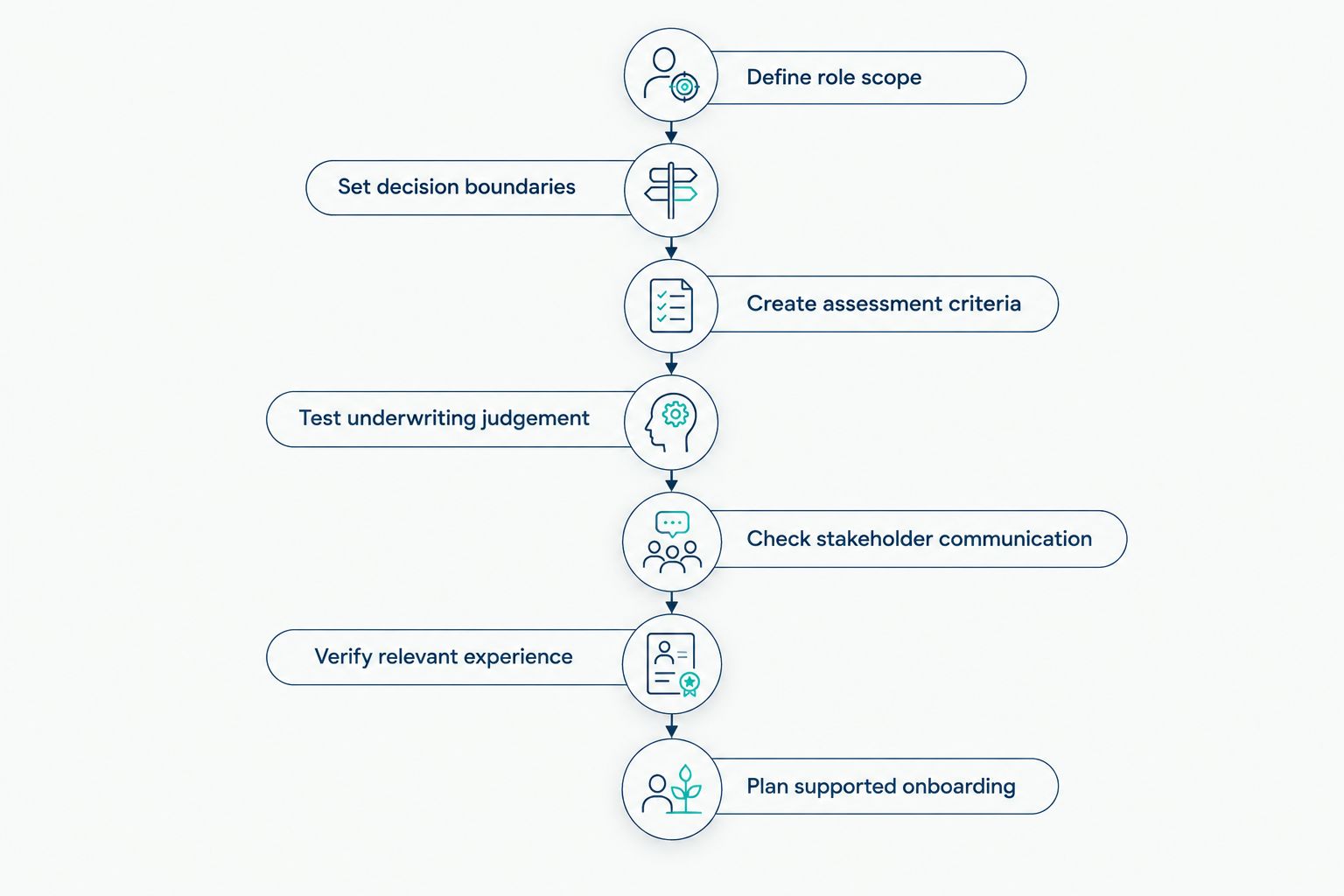
Start with your existing role description, underwriting framework and an ordinary document or spreadsheet. You do not need a new platform to create a useful brief. The following sequence separates role design, assessment and appointment decisions so each stage has a clear owner.
Define role scope
Describe the work before describing the person. Identify the classes of business, customer segment and distribution channels involved, then explain whether the vacancy covers new business, renewals, portfolio management or a combination.
Distinguish work the employee performs independently from work reviewed by a senior underwriter. A requirement to prepare recommendations is not equivalent to authority to accept risks. Make that distinction explicit in both the advertisement and interview brief.
For your 2026 hiring brief, describe the current portfolio rather than recycling an older position description. If the role has changed, explain what changed and which responsibilities remain unsettled.
- Name the insurance classes and relevant product experience.
- Describe new business, renewal and portfolio responsibilities separately.
- Identify broker-facing, direct customer and internal stakeholder contact.
- Record reporting lines, working arrangements and the reason for hiring.
Set decision boundaries
Ask the underwriting leader to document the role’s decision boundaries using the employer’s current framework. Include referral triggers, review requirements and responsibility for recording the rationale behind decisions.
Assess authority through examples, not job titles. Ask candidates what they decided independently, what needed approval and how they handled an exception. Keep previous employers’ confidential limits and commercial information out of the discussion.
You can prepare these questions internally. From this stage, HAYLO People’s General Insurance recruitment service is an option for employers seeking specialist recruitment support; the insurer still needs to define its own authority framework and technical requirements.
- Separate independent decisions from recommendations requiring approval.
- Explain escalation contacts and referral expectations.
- Ask for anonymised examples of judgement within authority.
- Confirm who approves the technical assessment before recruitment begins.
Create assessment criteria
Build a scorecard around evidence that matters to the vacancy. Separate essential capability from knowledge that the employer can teach, and avoid treating every desirable attribute as a rejection rule.
Use 3 assessment categories as a starting structure: technical judgement, commercial reasoning and communication. Add role-specific detail beneath each category rather than creating a long list of overlapping personality descriptors. Define what an acceptable answer demonstrates before meeting candidates.
For a 2026 appointment, challenge requirements carried forward without a clear reason. If experience in an adjacent insurance class is acceptable, specify the learning support and supervision needed instead of leaving interviewers to make inconsistent exceptions.
- Define essential evidence for each assessment category.
- Separate trainable product knowledge from immediate job requirements.
- Record acceptable transferable experience and its limitations.
- Agree who scores each criterion and resolves conflicting assessments.
Test underwriting judgement
Prepare 2 fictional risk scenarios based on the work, with no identifiable customer information. One can test an ordinary submission; the other can introduce incomplete information or a referral issue. Give candidates the context needed to respond fairly.
Ask what further information they need, how they would reason through the submission and when they would escalate. The aim is to see the decision process, not to reward someone for guessing your preferred answer or remembering an internal rule they have never seen.
Keep the exercise bounded and relevant. Do not ask candidates to produce usable underwriting work on live submissions, and do not request documents belonging to a previous employer.
- Use fictional submissions with the same core facts for each candidate.
- Ask candidates to explain information gaps and proposed next steps.
- Test how candidates recognise the limits of their authority.
- Record reasoning against the agreed scorecard immediately afterwards.
Check stakeholder communication
Underwriters need to explain decisions to the people affected by them. Test the communication required by your vacancy, whether that involves brokers, internal distribution teams, claims colleagues or senior underwriting stakeholders.
A broker-facing exercise should assess how a candidate explains a decision without making commitments outside authority. An internal exercise can test whether the candidate identifies missing information and communicates a referral clearly. Neither needs to become a presentation competition.
For 2026 interviews, give every candidate the same communication task and relevant background. Judge the substance, clarity and appropriateness of the explanation rather than personal similarity to the existing team.
- Ask for a plain-language explanation of an underwriting decision.
- Test how the candidate handles a challenged decision or missing information.
- Assess whether the explanation identifies next steps and ownership.
- Separate communication requirements from subjective impressions of confidence.
Verify relevant experience
Use reference checks to investigate the responsibilities and behaviours relevant to the role. Agree the reference-check process with the candidate, including permission before approaching a current employer, and follow your organisation’s privacy requirements.
Ask referees about the candidate’s work context and observed conduct, not simply whether they would employ the person again. A useful reference distinguishes direct observation from assumption and clarifies the referee’s working relationship with the candidate.
Treat unverified CV statements as questions to resolve. If an interview, exercise and reference give different pictures of experience, investigate the difference before making the appointment decision.
- Confirm role responsibilities and the referee’s working relationship.
- Ask about observed judgement, escalation and documentation habits.
- Explore development needs relevant to the proposed vacancy.
- Record unresolved questions and assign responsibility for follow-up.
Plan supported onboarding
Decide how the new underwriter will become familiar with your products, systems and authority framework. Recruitment evidence does not replace employer induction or the internal approvals required before someone exercises authority.
Create a 30-day onboarding checklist as a planning tool, not a promise that every employee will be independently authorised within that period. Include access, supervision, referral contacts and opportunities to review early decisions with the underwriting leader.
For a 2026 start, confirm the current versions of underwriting guidance and escalation arrangements. Temporary and senior appointments also need a clear handover; experience elsewhere does not remove the need to understand this employer’s controls.
- Assign an onboarding owner and technical supervisor.
- Arrange appropriate system access and current guidance.
- Document authority approval and referral arrangements.
- Schedule reviews of early work and outstanding learning needs.
The recruitment sequence should finish with an agreed support plan, not simply an accepted offer. Keep the assessment record available to the onboarding owner so any identified learning needs become specific induction tasks.
Choose the employment arrangement around the work
Permanent, temporary and executive recruitment answer different staffing questions. Best for should describe the work you need done, not a preferred label attached before the role is understood.
HAYLO People provides permanent, temporary and executive staffing services. For General Insurance recruitment, the employer still needs to establish the vacancy’s scope, decision rights and appointment requirements; external recruitment support does not replace those responsibilities.
| Option | Best for | Practical advantage | Key limitation |
|---|---|---|---|
| Permanent appointment | An ongoing underwriting position | Aligns the appointment with continuing role responsibilities | Still requires a clear development and authority plan |
| Temporary appointment | A defined period of underwriting work or cover | Lets the brief focus on a bounded assignment | Requires explicit access, handover, supervision and assignment boundaries |
| Executive appointment | An underwriting leadership vacancy | Centres assessment on leadership remit and decision ownership | Does not substitute for defining the hands-on technical work required elsewhere |
Do not assume a temporary underwriter can absorb any unfinished work or that a senior title guarantees experience in your insurance class. Describe the assignment in the same operational detail you would use for a permanent vacancy.
Before requesting recruitment support, record the employment arrangement, approval status and person authorised to make the hiring decision. Resolve disagreements internally first. A recruiter cannot reliably assess against a brief that changes between interviewers.
Common mistakes general insurers make
Treating adjacent insurance experience as identical
Experience in claims, Insurance Broking or another underwriting class can inform a candidate’s understanding without proving readiness for the vacancy. Ask which responsibilities transfer directly and which require training. Do not reject transferable experience automatically, but do not treat familiarity with insurance terminology as evidence of underwriting authority.
Letting commercial confidence replace technical evidence
A persuasive interview answer does not show how someone handles incomplete information or a decision outside authority. Pair discussion of commercial outcomes with a fictional submission. Ask the candidate to explain the reasoning, documentation and referral steps behind the proposed response.
Changing the brief after meeting candidates
Adding requirements mid-process creates inconsistent assessment. If interviews reveal a genuine gap in the brief, pause and revise it openly. Apply the revised criteria consistently rather than using a new preference to justify a decision already made.
Confusing specialist knowledge across divisions
General Insurance, Insurance Broking, Personal Injury and Work Health & Safety involve different work contexts. For this underwriting vacancy, test the relevant product and decision-making experience. If the remit includes workers compensation or other scheme-specific work, verify the actual jurisdiction and responsibilities rather than assuming experience transfers unchanged.
Leaving supervision until the start date
An offer does not settle who reviews early decisions, approves access or explains referral pathways. Nominate those owners before the employee starts. Where the assessment identified a learning need, put the support into the onboarding plan instead of expecting the new employee to identify it alone.
FAQ
What should a general insurer include in an underwriter recruitment brief?
Include the insurance classes, portfolio responsibilities, distribution channels, authority expectations and assessment criteria. Also identify the hiring approver, working arrangements and support available during onboarding.
How do I assess an underwriter’s technical judgement?
Use a fictional risk submission and ask the candidate to explain information gaps, decision reasoning and referral requirements. Assess the response against criteria agreed before interviews rather than an interviewer’s overall impression.
Should I only consider underwriters from the same insurance class?
Base that decision on the work the employee must perform immediately and the training you can provide. Adjacent experience needs a structured assessment of transferable capability, product knowledge and supervision needs.
Can a general insurer recruit a temporary underwriter?
Temporary recruitment is an option for a defined underwriting assignment or period of cover. Specify the assignment boundaries, access requirements, authority arrangements and handover responsibilities before seeking candidates.
Does broker experience prove someone can work as an underwriter?
Broker experience alone does not establish underwriting decision-making capability. Assess the candidate’s relevant responsibilities, technical reasoning and understanding of authority boundaries against the actual vacancy.
How can HAYLO People support underwriter recruitment?
HAYLO People provides specialist General Insurance recruitment and places permanent, temporary and executive staff. Employers should bring a defined vacancy brief and retain ownership of technical assessment, authority approval and onboarding.
What should happen before a new underwriter starts making decisions?
The employer should confirm the employee’s authorised responsibilities, required approvals and referral arrangements. Complete relevant induction and access checks, and explain who reviews work while the employee learns the portfolio.
One last thing
Use the same fictional submission during assessment and supervised onboarding. Ask the new employee to revisit the reasoning after learning your underwriting framework. The comparison gives the supervisor a concrete discussion point about what has changed, what remains unclear and where further guidance is needed.
For your next vacancy, prepare the brief before making a recruitment enquiry. Include role scope, decision boundaries and the evidence you want assessed; that gives the employer and recruitment consultant a specific starting point.