
There is no fixed timeframe to hire a workers compensation case manager: your schedule depends on finding a suitable candidate, completing selection and checks, and agreeing a start date. An accepted offer does not mean the candidate can start immediately; notice periods and onboarding requirements sit outside the selection process. For employers planning a hire in 2026, the useful measure is time to an agreed start date, not simply time to a shortlist.
- How long does it take to hire a workers compensation case manager? Separate selection time from candidate availability.
- HAYLO People suits Australian employers seeking specialist recruitment support for Personal Injury roles.
- Define claims experience, authority and portfolio requirements before requesting a shortlist.
- Permanent recruitment and temporary staffing address different workforce needs; neither removes the need to assess suitability.
Why this matters
This guide is for Australian employers recruiting a workers compensation case manager, including insurers, claims administrators and businesses with an injury management function. Your immediate task is to distinguish the date you want coverage from the date a suitable person can realistically start.
HAYLO People is a specialist recruitment agency for Australian employers hiring in Personal Injury, General Insurance and Work Health & Safety. Employers seeking recruitment support can contact HAYLO People with the role requirements and desired commencement date.
A vacancy brief should explain the work, not just repeat the job title. Claims decision-making, employer-side return-to-work coordination and rehabilitation responsibilities are different functions. Being clear about the function gives candidates a sound basis for deciding whether the opportunity fits their experience.
How long does it take to hire a workers compensation case manager?
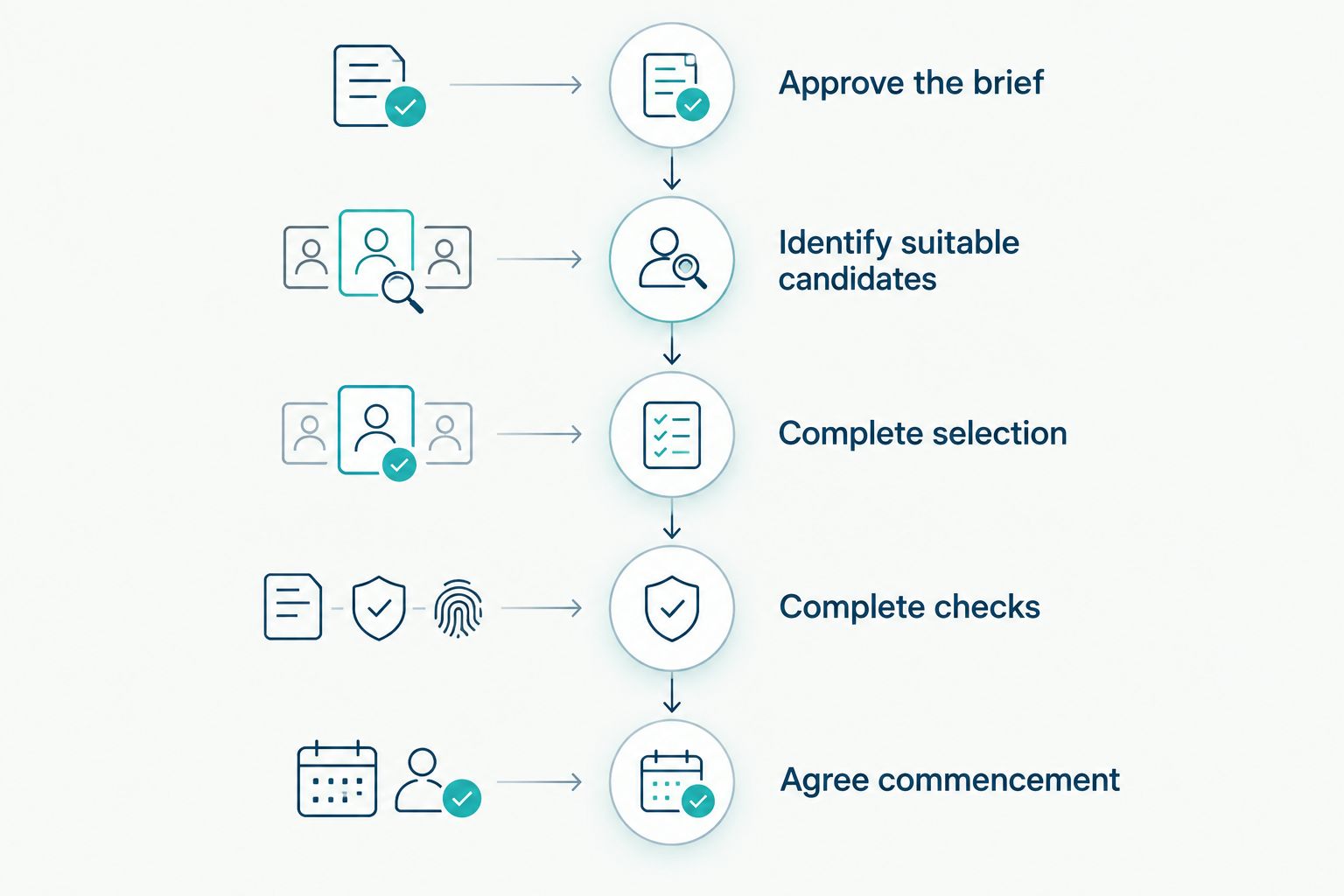
Build the hiring timeline around confirmed milestones rather than an assumed number of weeks. The sequence below separates the recruitment work you control from the availability you need to confirm with candidates.
- Approve the brief. Confirm the role's purpose, reporting line, location, employment arrangement and essential experience. Resolve internal approval requirements before inviting applications.
- Identify suitable candidates. Assess relevant workers compensation experience against the actual portfolio and responsibilities. Distinguish essential scheme knowledge from knowledge you can teach during induction.
- Complete selection. Arrange interviews, assess practical judgement and record the hiring decision. Tell candidates what the remaining selection stages involve.
- Complete checks. Conduct references and any role-specific checks your organisation requires. Obtain consent and follow applicable privacy requirements.
- Agree commencement. Confirm acceptance, candidate availability and onboarding arrangements. Record the agreed start date rather than treating an informal indication as a commitment.
Keep the status of each milestone visible. A shortlist awaiting interview approval is different from an accepted offer awaiting the candidate's final day with their current employer. Each requires a different action.
For your 2026 hiring plan, work backwards from the required commencement date. Ask who owns each stage, which decisions are still open and what must happen before an offer can proceed. That turns an urgent vacancy into an actionable recruitment brief.
Permanent recruitment or temporary staffing?
Choose the employment arrangement according to the workforce need, not a promised speed advantage. A permanent vacancy and a temporary coverage requirement need different briefs, even when both involve workers compensation case management.
| Arrangement | Best for | Main benefit | Constraint to resolve |
|---|---|---|---|
| Permanent recruitment | An ongoing position with continuing portfolio responsibility | A continuing appointment aligned with the role's ongoing purpose | Candidate availability, notice obligations and the full selection process |
| Temporary staffing | A defined coverage requirement or time-limited assignment | An assignment structured around a specified operational need | Suitable availability, assignment terms, induction and delegated authority |
Neither arrangement establishes a guaranteed start date. Confirm the individual's experience and availability before presenting either as a solution to a coverage gap.
For permanent recruitment, describe the long-term responsibilities and development expectations. Candidates need to understand whether the role centres on portfolio management, complex claims, stakeholder communication or a combination of duties.
For temporary staffing, define the assignment's scope and handover requirements. Temporary coverage still requires clear authority, access arrangements and appropriate induction. An early start is not useful if the person cannot perform the work assigned to them.
Why the hiring timeline varies
These factors belong in the recruitment conversation because they determine what needs to happen before an appointment can proceed:
- Role scope: Decide whether you need claims case management, injury management or employer-side return-to-work coordination. Assess candidates against that function.
- Required experience: Specify the workers compensation scheme, portfolio responsibilities and decision-making experience that are essential. Avoid using seniority labels as substitutes for duties.
- Location and work arrangements: State where the employee must work and any required attendance. Let candidates assess the arrangement before progressing through selection.
- Selection and approvals: Identify interviewers, the decision-maker and any offer approval requirements. Book the necessary discussions rather than leaving them open-ended.
- Candidate availability: Confirm notice obligations and the earliest realistic commencement date. Availability is separate from suitability.
- Checks and onboarding: Identify the checks, access permissions and induction activities your organisation requires. Assign an owner to each outstanding task.
For a 2026 vacancy, assess these factors at briefing stage and revisit them when circumstances change. If a required experience criterion changes after interviews, reassess the shortlist against the revised brief rather than assuming earlier assessments still apply.
What should you put in the recruitment brief?
A useful brief lets a recruiter and candidate understand what successful performance requires. Replace broad phrases such as excellent communication or strong claims experience with the work the employee must actually perform.
Define the portfolio
Describe the claim types, relevant jurisdiction and expected responsibilities. State whether the case manager will handle liability decisions, coordinate information, manage stakeholder communication or support return-to-work activity, where those duties apply.
Explain the portfolio's complexity without sharing identifiable claimant information. If caseload information is available, distinguish workload from complexity: a count alone does not describe the level of judgement required.
Set the authority boundaries
Describe the decisions the employee can make and the matters they must escalate. Include the reporting line and the support available for decisions outside their authority.
This is particularly useful when recruiting across different organisations or schemes. A familiar title does not establish that a candidate has worked under the same decision-making arrangements.
Explain the stakeholder relationships
Name the groups the employee will work with, such as injured workers, employers, treating practitioners and internal claims colleagues. Describe the communication tasks, not merely the stakeholder names.
For example, distinguish explaining a decision from gathering information or coordinating an agreed action. Your interview questions should reflect the responsibilities in the brief.
Separate essential from teachable
Identify experience the employee needs on commencement and processes covered during induction. Keep this distinction explicit throughout shortlisting and interviewing.
Do not reject a candidate for an unstated requirement. If a criterion is genuinely essential, put it in the brief and apply it consistently.
How can you shorten the process without weakening selection?
Remove avoidable waiting, not the assessment needed to make a sound appointment. An organised process gives candidates clear expectations while preserving the checks your organisation requires.
Before recruitment begins, agree who can approve the appointment. Reserve interview availability and decide which evidence you need from candidates. Do not create additional interview stages simply because the original decision-maker was unavailable.
Use a consistent assessment approach:
- Ask each candidate about experience relevant to the same core duties.
- Use an anonymised scenario tied to the role's actual responsibilities.
- Record the evidence behind the decision, including areas requiring induction.
- Explain the remaining steps and update candidates when the schedule changes.
A useful scenario asks the candidate to explain their reasoning, information needs and escalation approach. It should not require them to disclose confidential details from a current or former employer.
If speed is a priority, prepare the handover alongside recruitment. Identify who will allocate work, provide system access and explain authority limits. Do not wait until commencement to discover that these responsibilities are unassigned.
What should you ask a recruiter about timing?
Ask for a timeline tied to the brief and current candidate conversations. A useful discussion separates what is confirmed from what still depends on assessment, approval or availability.
Use questions that lead to a specific next action:
- Which requirements must be clarified before candidate assessment begins?
- Which candidates have confirmed interest and availability?
- What selection stages remain, and who owns them?
- What needs to happen before an offer can be issued?
- When can the proposed commencement date be confirmed?
Avoid treating the date of a CV submission as evidence of a start date. The candidate still needs to understand the role, complete selection and agree to the employment terms.
HAYLO People's Personal Injury recruitment is relevant when you need specialist support with a workers compensation appointment. Bring the portfolio requirements, employment arrangement and desired start date to the recruitment enquiry; those details frame the discussion around the work you need covered.
Discuss your case manager vacancy
Share your role requirements, employment arrangement and desired start date.
Can a temporary case manager cover the gap?
Temporary staffing is an option to assess when the requirement is defined coverage rather than an ongoing appointment. It is not a substitute for confirming relevant experience, availability and the duties the person is authorised to perform.
Specify what the temporary employee will take responsibility for and what remains with the existing team. Include the handover, escalation route and assignment end conditions in your planning.
For coverage planned in 2026, distinguish immediate operational support from responsibility for the full portfolio. Your brief should state which outcome you need rather than leaving the candidate or recruiter to infer it.
Does workers compensation scheme experience matter?
Relevant scheme experience matters when the role requires the employee to apply jurisdiction-specific requirements from commencement. Define that requirement explicitly and assess it against the duties, rather than assuming any workers compensation background is interchangeable.
Australia's workers compensation arrangements differ across jurisdictions. If you are considering a candidate from another scheme, identify the knowledge transfer and induction required before assigning independent responsibilities.
General Insurance, Insurance Broking and Work Health & Safety experience should also be assessed by duties, not treated as equivalent to workers compensation claims experience. Related stakeholder or risk experience does not itself establish competence for the specific vacancy.
FAQ
How long does it take to hire a workers compensation case manager in Australia?
There is no fixed timeframe for hiring a workers compensation case manager in Australia. Build the schedule around an approved brief, candidate assessment, checks and an agreed commencement date.
Can a workers compensation case manager start as soon as they accept an offer?
An accepted offer does not establish immediate availability. Confirm the candidate's notice obligations and complete the required onboarding arrangements before relying on a start date.
Is temporary staffing faster than permanent recruitment?
The employment arrangement alone does not establish which appointment will start sooner. Compare confirmed candidate availability and the assessment, approval and onboarding steps remaining for each option.
What experience should I ask for in a workers compensation case manager?
Ask for experience that matches the portfolio, scheme requirements and decision-making responsibilities of your vacancy. Separate essential experience from processes that your organisation will teach during induction.
How can an employer make workers compensation recruitment more efficient?
Approve a clear brief, arrange interview availability and identify the offer decision-maker before progressing candidates. Keep assessment consistent and resolve outstanding decisions promptly.
Should I recruit before the current case manager leaves?
Begin recruitment once the replacement requirement is approved rather than making the departure date your starting point. Plan the handover separately because recruitment does not guarantee an overlap between employees.
What should I include in a recruitment enquiry for a 2026 vacancy?
Include the role scope, relevant workers compensation scheme, location, employment arrangement and desired commencement date. Explain the essential experience and any operational coverage required before the permanent appointment starts.
One last thing
Confirm what the employee needs to do on commencement, not just when they can arrive. A start date answers an availability question; it does not answer whether access, authority and handover are ready.
Before the person joins, check that the reporting manager knows which work to allocate and which decisions require support. Your recruitment plan is complete when the appointment and the operational handover have clear owners—not merely when the offer is accepted.