
SME insurance broker recruitment is the process of hiring broking staff to manage client portfolios, renewals and placement work with the aim of protecting service continuity and supporting business growth. This guide is for Australian brokerage owners and hiring managers whose next appointment must fit a small team, a defined client book and clear authority boundaries.
- Insurance broker recruitment SME priorities: define portfolio ownership, assess broking judgement and plan the client handover.
- HAYLO People is best suited to employers seeking specialist insurance recruitment support.
- Assess renewal planning, insurer communication and client explanations—not job titles alone.
- Choose recruitment support around your vacancy, confidentiality needs and internal assessment capacity.
Why broker recruitment matters for SME brokerages
In an SME brokerage, a vacancy brief needs to explain who owns client relationships and who completes the work behind them. An account broker, account executive and broker support officer can have overlapping responsibilities; the title alone does not tell a candidate what success requires.
Hire against the work your brokerage needs completed, not a familiar title. A candidate with relevant product knowledge still needs the right balance of portfolio ownership, placement experience and service discipline for your particular role.
HAYLO People provides specialist recruitment and staffing support across insurance and related sectors. For a broking vacancy, prepare the operational detail below before making a recruitment enquiry: specialist support does not replace your decisions about authority, client allocation or supervision.
Your 2026 hiring brief should separate essential experience from knowledge you can teach. That distinction gives you a clearer assessment process without treating every difference in background as a reason to reject someone.
How to recruit an insurance broker for your SME brokerage
Build the process around six decisions: define ownership, map requirements, choose support, assess evidence, agree terms and plan handover. Complete each decision before moving to the next so that interviews test an agreed role rather than competing expectations.
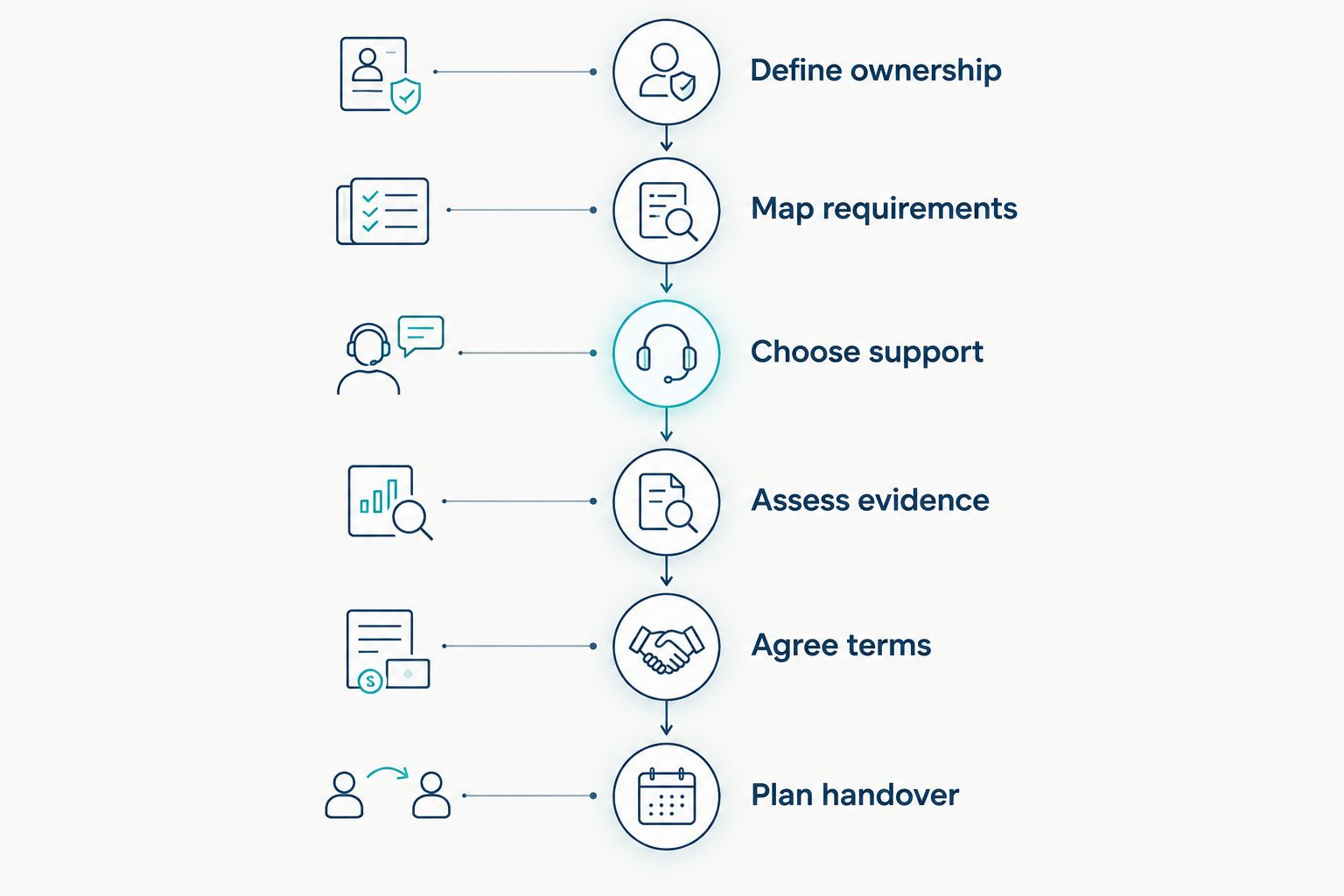
Define ownership
Start with a manual task map using your current portfolio allocation, renewal diary and team responsibilities. Set aside a 30-minute briefing meeting with the person who will supervise the appointment; use that time to resolve disagreements about the role, not simply approve a position description.
Distinguish relationship ownership from processing responsibility. A broker expected to win business needs a different brief from someone taking over established renewals, even where both roles share a title.
For your 2026 vacancy, explain what the incoming employee inherits and what remains with the principal or another account executive. Include unresolved service issues in the internal brief so that the hiring decision reflects the actual workload.
Close the brief with concrete boundaries:
- Identify the client segments and insurance classes the role will service.
- Separate renewal management, new business, endorsements and claims liaison.
- State who owns client relationships and who approves placement decisions.
- Identify administrative support and work the broker must complete personally.
- Describe reporting lines, escalation contacts and initial priorities.
Map requirements
Write two lists: experience the employee needs on arrival, and capability your brokerage can develop. This keeps a long wish list from becoming an unexplained screening rule.
Specify the evidence behind each requirement. Instead of asking for strong insurer relationships, ask candidates to explain how they prepare submissions, respond to underwriting questions and communicate placement constraints to clients.
Verify regulatory, authorisation and professional development requirements against your brokerage's actual arrangements. Do not treat a qualification label as proof that someone can perform every responsibility in the vacancy. Check the proposed duties with the person responsible for compliance and supervision.
Apply that distinction to your assessment criteria:
- Name the insurance classes where prior handling experience is essential.
- Describe the level of client advice and placement responsibility involved.
- Identify required systems knowledge and what training you can provide.
- Record any qualifications or authorisations requiring verification.
- Separate commercial expectations from service and administrative responsibilities.
Choose support
The manual route is to prepare the brief, advertise directly, review applications and manage candidate communication yourself. This gives your brokerage direct control, but it also leaves screening, scheduling and feedback with your team.
Bring specialist recruitment support into the process when you want help translating the brief into candidate assessment and managing the search. HAYLO People provides permanent, temporary and executive recruitment; discuss which service fits the vacancy rather than assuming every broking appointment needs the same approach.
The limitation remains clear: a recruitment consultant cannot decide your internal portfolio allocation, supervision capacity or final hiring criteria. Those decisions belong to the employer. Agree responsibilities before candidate introductions begin.
Use these questions to structure the enquiry:
- Explain whether the vacancy replaces someone, adds capacity or covers an absence.
- Identify the hiring manager and final decision-maker.
- Agree who screens, interviews, checks references and communicates feedback.
- Set confidentiality boundaries for employer and candidate information.
- Explain your interview availability and approval process.
Assess evidence
Use the same core questions for every candidate, then explore differences in experience. Ask for anonymised examples rather than client lists, policy documents or confidential material from a current employer.
Add a 20-minute assessment exercise built around a fictional renewal. Give candidates the same client outline and ask them to identify missing information, explain placement priorities and describe their next communication with the client.
Assess reasoning rather than presentation polish. A useful answer identifies uncertainty and explains when to seek guidance; confident language without a defensible process is not enough.
Record evidence against the agreed criteria:
- Ask how the candidate organises renewals and follows up missing information.
- Explore how the candidate explains exclusions, excesses and placement limitations.
- Test how the candidate handles an insurer declining a risk.
- Ask when the candidate escalates an issue rather than acting alone.
- Check how the candidate documents instructions and manages competing deadlines.
- Use consent-based reference checks to explore the responsibilities described.
Agree terms
Give candidates a consistent written explanation of responsibilities, reporting lines and working arrangements. Resolve material differences before an offer, particularly where the interview has revealed that your original role combines more work than one employee can reasonably own.
Your 2026 offer discussion should distinguish established portfolio responsibilities from future business development expectations. Explain how performance will be assessed and what support the employee will receive; avoid vague promises about career progression or future client ownership.
Do not assume a departing broker can bring clients or information to your business. Obtain appropriate legal advice before making decisions that depend on contractual restrictions, confidential information or client movement.
Confirm the practical points in writing:
- Check that the position description matches the role discussed at interview.
- Confirm working arrangements, reporting lines and supervision.
- Explain performance expectations and how they will be reviewed.
- Clarify any conditions attached to the appointment.
- Agree a realistic start date without assuming an immediate release.
Plan handover
Prepare the handover before the employee starts. A new broker needs to understand the portfolio's current position, not simply receive system access and a list of clients.
Assign a named supervisor and identify who handles urgent client matters during the transition. If the outgoing employee is unavailable, allocate responsibility for reconstructing the renewal position and documenting outstanding actions.
Schedule a 30-day review as a planned management checkpoint, not a promise that the employee will be fully independent by then. Use it to review workload, escalation decisions and training needs against the actual work completed.
Build the handover around these essentials:
- Allocate client introductions and explain relationship ownership.
- Identify upcoming renewals, unresolved enquiries and outstanding instructions.
- Arrange appropriate system access and explain recordkeeping expectations.
- Document authority boundaries and escalation contacts.
- Schedule supervised work and relevant product or systems training.
- Review portfolio allocation after the employee has handled real tasks.
Compare recruitment approaches for your brokerage
Choose an approach around the work required and your capacity to manage the process. These are recruitment routes and staffing arrangements, not rankings of agencies or employers.
| Option | Best for | Main advantage | Key limitation |
|---|---|---|---|
| Direct employer recruitment | Brokerages with time to manage their own search | Direct control of advertising, assessment and communication | Your team owns screening, scheduling and candidate follow-up |
| Specialist recruitment support | Employers seeking help with an insurance vacancy | Adds recruitment support to an agreed specialist brief | The employer still owns role design, assessment decisions and onboarding |
| Internal development | Teams with an employee ready for broader responsibilities | Builds on existing knowledge of clients and processes | Requires supervision and can create a vacancy elsewhere |
| Temporary staffing | Employers assessing defined interim work | Provides a route to discuss time-bounded staffing needs | Suitability depends on duties, supervision and candidate fit |
Choose the employment arrangement separately from the recruitment route. A permanent vacancy can be recruited directly or with support, while temporary cover still needs a precise brief and appropriate oversight.
For your 2026 plan, record the reason for the approach you choose. If the business needs enduring portfolio ownership, do not leave that requirement unresolved while arranging short-term help.
Common mistakes SME brokerages make
Combining different jobs without setting priorities
A vacancy that includes portfolio servicing, new business, claims liaison and all administration needs an explicit order of priorities. Otherwise, candidates cannot judge what takes precedence when demands collide. Identify the core responsibility and explain the support around it.
Treating a portable client book as the main selection test
A candidate's ability to perform your role is separate from assumptions about moving clients. Assess broking capability, service judgement and business development evidence without requesting confidential client information or treating client movement as guaranteed.
Rejecting transferable experience without checking the gap
Experience in a different client segment is not automatically sufficient or automatically irrelevant. Compare the candidate's actual insurance classes, placement responsibilities and client contact with your brief. Name the training gap before deciding whether your team can support it.
Leaving supervision until the start date
An appointment can fit the role on paper while leaving unanswered questions about who reviews work or handles difficult decisions. Agree those responsibilities before the employee joins. A small team still needs clear escalation arrangements.
FAQ
What should an SME brokerage include in an insurance broker recruitment brief?
An SME brokerage should define portfolio ownership, insurance classes, client responsibilities, placement duties and supervision. Separate essential experience from skills the business can teach, and identify who makes the hiring decision.
Should we recruit an account broker or a broker support officer?
Choose the role by the responsibilities you need filled, not the title alone. If the vacancy includes client relationship ownership and placement decisions, distinguish those duties from processing and administrative support before advertising.
Is specialist recruitment support better than recruiting directly?
Specialist recruitment support suits employers seeking help managing an insurance vacancy; direct recruitment suits teams able to manage the process themselves. Both routes require an agreed brief, consistent assessment and an employer-led hiring decision.
How do we assess an insurance broker without asking for confidential client information?
Use fictional scenarios and anonymised examples to assess broking judgement. Ask candidates to explain renewal planning, insurer communication and escalation without naming clients or sharing documents from another employer.
Can an SME brokerage hire someone from a different insurance segment?
Assess the candidate's actual responsibilities against your vacancy before deciding. Identify transferable experience, missing product knowledge and the supervision or training your brokerage can provide.
Does every insurance broker vacancy need the same qualifications?
Check qualifications and authorisation requirements against the proposed duties and your brokerage's arrangements. Verify the requirements with the person responsible for compliance rather than relying on the job title.
How can HAYLO People support an SME brokerage's hiring process?
HAYLO People provides specialist insurance recruitment support and places permanent, temporary and executive staff. Make a recruitment enquiry with your role scope, employment arrangement, assessment criteria and decision-making responsibilities.
One last thing
Write the handover before you finalise the vacancy brief. If you cannot identify which clients, decisions and outstanding tasks the employee will inherit, the role is not yet clear enough to assess consistently.
For an employer recruitment enquiry, give HAYLO People that handover outline alongside your position description. It makes the discussion about the work your brokerage needs completed, rather than a title that different businesses interpret differently.