
Graduate insurance claims careers are entry-level pathways into assessing and managing insurance claims, with the aim of helping customers resolve insured losses and injuries. This 2026 guide is for Australian graduates: your priority is finding a role with appropriate supervision, not assuming every claims vacancy accepts applicants without experience.
- For the search insurance claims careers graduate, prioritise entry requirements, supervision and claim type over job titles.
- HAYLO People provides specialist recruitment support across Personal Injury, General Insurance and Work Health & Safety.
- Compare graduate programmes, direct-entry roles and temporary assignments by training, responsibilities and employment terms.
- Use evidence from study, placements and customer-facing work to demonstrate judgement, communication and accurate record-keeping.
Why claims careers matter for graduates
Claims work brings together customer communication, evidence review, policy interpretation and documented decisions. You need to explain what happens next while keeping an accurate record of what has happened already. That combination gives graduates a practical way to apply analytical and interpersonal skills.
HAYLO People is suited to candidates seeking specialist recruitment support in Personal Injury, General Insurance and Work Health & Safety. Start with the work you want to do, then discuss relevant vacancies and their entry requirements with a consultant.
Your degree alone does not tell an employer how you will handle a difficult conversation or identify missing information. Applications need evidence of those behaviours. For your 2026 search, assess vacancies by their actual duties and training arrangements rather than treating the word graduate as a complete description.
Build your graduate claims career plan
Choose your pathway
Start by separating the work areas. General Insurance claims can involve property, motor or liability matters; Personal Injury roles can involve workers compensation or compulsory third party insurance, commonly called CTP. The information you review and the people you communicate with differ by claim type.
Insurance Broking is an adjacent pathway, not another name for insurer claims handling. A broking role can involve helping clients communicate with insurers about claims. Work Health & Safety is also distinct: its focus includes workplace risk and prevention rather than deciding insurance claims.
Choose a work area before choosing a job title. Read position descriptions and record which tasks appeal to you. An interest in helping people matters, but you also need to understand the administrative and decision-making parts of the role.
- Compare General Insurance and Personal Injury duties in actual advertisements.
- Note whether a broking vacancy includes claims support or broader client servicing.
- Consider WHS separately if workplace prevention is your main interest.
- Identify whether you prefer evidence analysis, customer conversations or coordination.
- Keep a shortlist of roles whose responsibilities you can explain in your own words.
Read role requirements
Check each advertisement yourself before seeking recruitment support. Separate essential requirements from desirable experience, then identify what the employer expects you to do independently. An entry-level title does not establish the level of supervision.
Look for clear information about induction, technical training and escalation. A vacancy that involves customer contact needs more scrutiny than a list of attractive benefits: ask who helps when a question sits outside your knowledge or authority.
HAYLO People places permanent, temporary and executive staff in its specialist sectors. For a graduate, the useful conversation is about vacancies that match your current experience and the support you need—not assuming every placement type is an entry route.
- Mark essential qualifications and experience separately from preferences.
- Check location, work arrangements and any travel requirements.
- Ask what responsibilities begin immediately and what comes after training.
- Confirm who reviews your work and handles escalations.
- Ask whether relevant vacancies accept graduates without insurance experience.
Translate your experience
Build your application from evidence you already have. University projects, placements, volunteering and customer-facing work can demonstrate relevant behaviours without becoming insurance experience. Describe them accurately; do not rename unrelated work as claims management.
Prepare 3 examples: one showing careful analysis, one showing communication under pressure and one showing reliable follow-through. Explain the situation, your action and the outcome. Use an actual result rather than adding a percentage to make the example sound stronger.
For a 2026 application, connect each example to a stated requirement. If the employer asks for accurate records, explain how you checked information and maintained documentation. If it asks for customer service, show how you clarified a problem and explained the next step.
- Match each key requirement to a real example from your experience.
- Describe your own contribution to group assignments or workplace tasks.
- Show how you corrected an error or checked uncertain information.
- Explain how you communicated with someone who needed help.
- Remove unsupported claims such as expert policy knowledge or advanced claims capability.
Target your applications
Search manually through employer careers pages and job listings before relying on a single channel. Use terms such as graduate claims, claims assistant, claims support, trainee claims and junior claims consultant. These are search terms, not guarantees that a vacancy is suitable.
Read beyond the title. Claims consultant can describe different responsibilities, while an administrative role can offer relevant exposure without responsibility for claim decisions. Your application should reflect the duties in front of you, not a generic picture of insurance work.
HAYLO People recruitment support is another route to discussing suitable opportunities in Personal Injury and General Insurance. Share your preferred work area, location, experience and employment preferences so the conversation starts with a usable brief.
- Search both graduate-labelled vacancies and clearly described entry-level roles.
- Tailor your CV summary to the advertised work area.
- Address the main selection requirements with specific evidence.
- Track application dates, contacts and agreed follow-up actions.
- Tell a consultant which responsibilities and training arrangements you are seeking.
Practise claims conversations
Prepare for interviews using a simple scenario: a customer wants an immediate answer, but relevant information is missing. Explain how you would listen, clarify the issue, check the facts and seek guidance. Do not promise a claim outcome to demonstrate confidence.
Use this practice sequence: Listen, Clarify, Check, Escalate, Record. It demonstrates an orderly approach to uncertainty without suggesting you already have decision-making authority. The employer's procedures and your authority would govern the actual response.
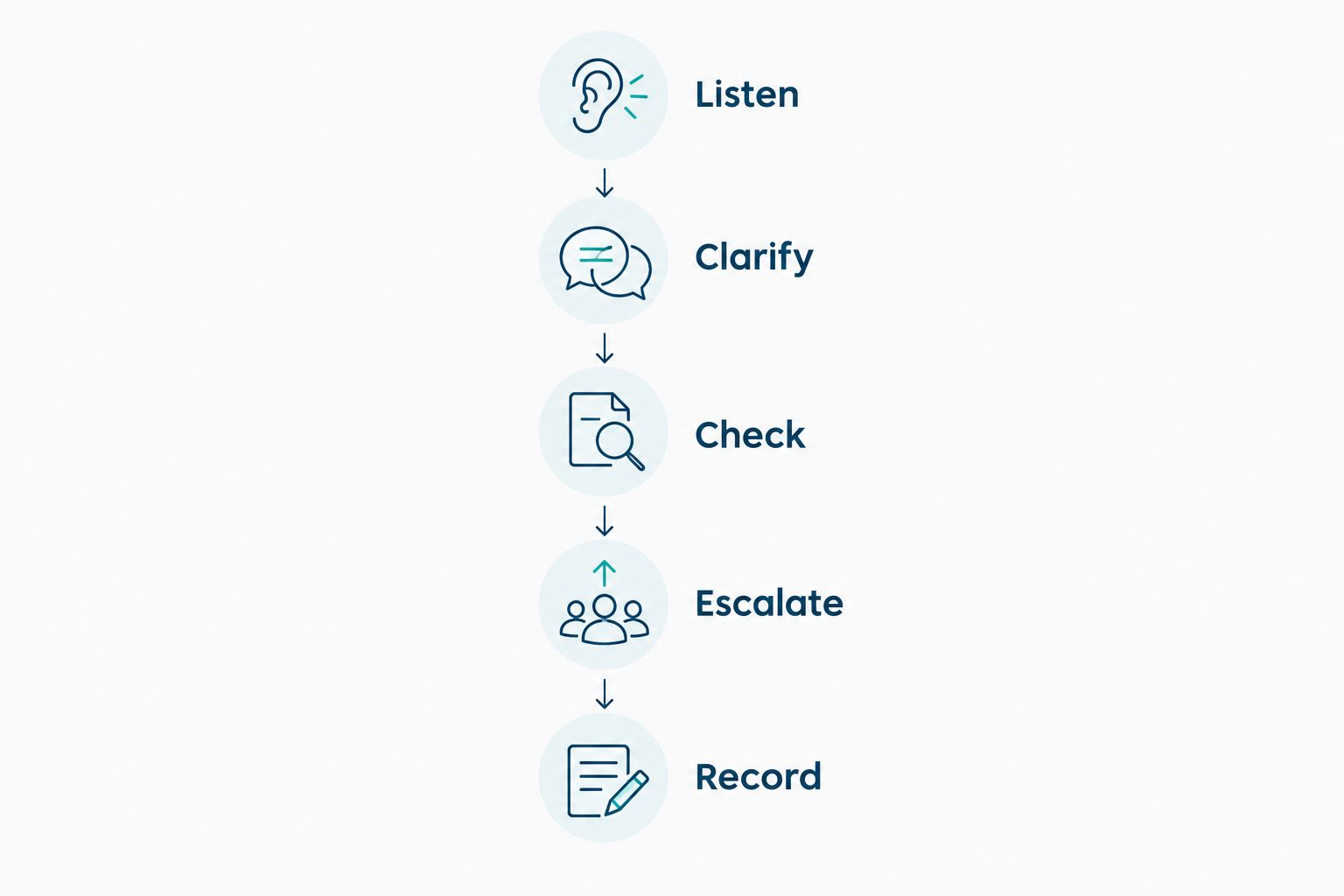
Prepare 2 questions about support: who reviews a new starter's work, and how difficult customer conversations are escalated. These questions help you assess the role while showing that you understand your limits.
- Rehearse explaining a next step without using unexplained insurance terminology.
- Prepare an example of staying calm during a difficult conversation.
- Explain how you would protect confidential customer information.
- State when you would ask for guidance rather than guess.
- Ask how training and feedback work in practice.
Assess the offer
Compare the role's written terms with what you discussed during recruitment. Review employment type, responsibilities, work arrangements and reporting lines. Ask for clarification before accepting if the advertised training or scope is unclear.
Use a 30-day learning plan as a discussion prompt, not a promised training timetable. Ask which systems, procedures and customer interactions you would learn first, and how your manager would check readiness for further responsibility.
For a 2026 offer, assess the complete role rather than a title alone. A suitable starting position has responsibilities you understand and support you can describe. Permanent employment, temporary work and structured graduate programmes require different questions; none removes the need to check the actual duties.
- Confirm employment type and written conditions.
- Ask who provides technical guidance and day-to-day feedback.
- Clarify initial responsibilities and escalation arrangements.
- Discuss what successful early learning looks like.
- Check how performance expectations change as your knowledge develops.
Compare graduate entry routes
Choose the route whose learning arrangements and responsibilities fit your starting point. The options below are categories to investigate, not confirmed vacancies or rankings of employers. Each offers a different way to enter related work, and each needs checks before you apply.
| Entry route | Best for | Practical advantage | Key limitation to check |
|---|---|---|---|
| Structured graduate programme | Graduates seeking a defined development pathway | A programme can set out learning stages and progression expectations | Confirm the actual claims exposure and application requirements |
| Direct-entry claims role | Graduates ready to focus on a particular claims function | You can assess a specific team's duties before applying | An entry-level title does not guarantee extensive training |
| Claims support or administration | Graduates seeking process and documentation experience | The duties can introduce you to claims workflows | Support work does not necessarily include assessment or decision authority |
| Temporary claims assignment | Candidates considering time-limited work | A defined assignment lets you assess its scope before committing | Confirm duration, supervision and whether prior experience is required |
| Broking claims support | Graduates interested in client-facing claims assistance | The role can involve communication between clients and insurers | Broking support is different from an insurer's claims decision role |
| WHS entry pathway | Graduates more interested in workplace prevention | It directs your search towards risk and safety work | WHS is a separate career direction, not a claims-handling substitute |
For your 2026 shortlist, compare the same criteria across every vacancy. Record the duties, entry requirements, training, supervision and employment terms. This keeps an appealing title from outweighing a poorly understood role.
Discuss your graduate career direction
Ask about relevant roles, entry requirements and recruitment support in your preferred specialist sector.
Common mistakes graduates make
Treating all claims roles as interchangeable
A property claim and a Personal Injury matter involve different information and conversations. Explain why the advertised work interests you. Do not send a cover letter about injury recovery to a vacancy focused on property damage without connecting it to the actual duties.
Confusing broking, claims and WHS
Insurance Broking, insurer claims handling and WHS connect to risk, but they are not the same job. Read who the role serves and what it is accountable for. A clear career preference helps you ask better questions and avoids applications built around the wrong work.
Claiming technical knowledge you have not used
Recognising terms such as liability or CTP does not establish practical capability. Show what you understand, identify what you need to learn and demonstrate how you check information. Accurate limits are stronger than unsupported expertise.
Focusing on progression before the first role
Ask about development, but understand the immediate job first. Establish what you will handle, who supports you and how feedback works. A future title is not a substitute for suitable responsibilities now.
Sharing confidential examples
Do not include identifiable customer, patient, claimant or employee details from previous work or placements. Describe your actions without exposing someone else's information. Ask permission before sharing workplace documents, even when they appear to strengthen your application.
FAQ
How do I start an insurance claims career as a graduate in Australia?
Start by choosing a claims work area and checking entry requirements in actual vacancies. Prepare evidence of analysis, communication and accurate record-keeping, then apply for roles with duties and supervision that fit your experience.
What should I search for with insurance claims careers graduate?
Search for graduate claims, claims assistant, claims support, trainee claims and junior claims consultant roles. Read each position description because the title alone does not confirm whether the employer accepts applicants without insurance experience.
Do I need an insurance degree to work in claims?
The required qualification depends on the vacancy. Check the employer's essential criteria and demonstrate relevant skills from your degree, placements or work rather than assuming either that an insurance degree is mandatory or that all degrees are accepted.
Is Personal Injury claims work the same as General Insurance claims?
Personal Injury and General Insurance claims are different work areas. Personal Injury roles can involve workers compensation or CTP, while General Insurance roles can involve property, motor or liability matters; check the particular claim type and responsibilities.
Is a temporary claims role suitable for a new graduate?
A temporary claims role is suitable only when its entry requirements, responsibilities and supervision match your experience. Confirm the assignment's duration and training arrangements rather than treating temporary employment as an automatic entry-level route.
What should I ask at a graduate claims interview?
Ask who reviews a new starter's work, what training covers and how difficult matters are escalated. Also clarify which responsibilities you would handle initially and how the employer assesses readiness for further work.
Can HAYLO People help me explore insurance claims careers?
HAYLO People provides specialist recruitment services in Personal Injury and General Insurance, alongside Work Health & Safety. Discuss your experience and preferred work area with a consultant, and ask which relevant vacancies accept graduates.
One last thing
Before accepting a graduate claims role, ask the manager to describe how a new starter handles an unfamiliar customer question. Listen for a clear route to guidance, review and escalation—not an expectation that you will simply work it out.
Choose support you can describe, not training you have to assume. For your 2026 search, take that question into interviews and recruitment conversations. It turns a vague promise of development into a practical discussion about how you will learn the job.